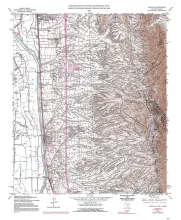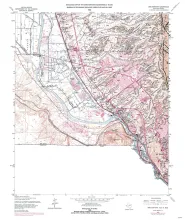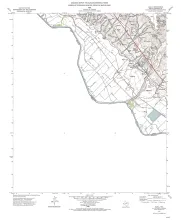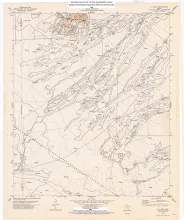
The hydrochemical history of ground water in the arid southeastern Hueco Bolson and southwestern Diablo Plateau was investigated by collecting soil-moisture samples from unsaturated siliciclastic bolson-fill sediments and groundwater samples from the Diablo Plateau aquifer, the Hueco Bolson silt and sand aquifer, and the Rio Grande alluvial aquifer. Major, minor, and trace solutes, stable isotopic compositions, and activities of tritium and carbon-14 were measured in ground-water samples; major solute concentrations were determined in soil-moisture samples.
Geologic mapping and fracture analysis of the Lower Cretaceous Edwards aquifer strata near Georgetown and Round Rock, Texas, were performed to provide a better understanding of the geologic framework of the Balcones Fault Zone and to provide information for assessing ground-water flow characteristics. Cretaceous strata dip gently eastward and are locally overlain by terrace deposits and alluvium. Several major normal faults, downthrown to the east, strike northward across the area. Gentle flexures, possibly related to faulting, parallel the faults.
The Ellenburger Group (Lower Ordovician) of Texas is a laterally extensive peritidal carbonate shelf sequence. It forms a major deep oil reservoir, having estimated reserves of 1.15 billion barrels of oil, and it also contains an estimated 2.2 billion barrels of oil equivalent.
4 oversized sheets, Lambert Conformal Conic projection based on standard parallel 33 degrees and 45 degrees. Accompanied by a text booklet, The Tectonic Framework of Texas.
Remotely sensed features such as linear drainages, escarpments, ridges, and aligned playas have been identified on Landsat imagery (scale 1:250,000) of the Texas Panhandle and adjacent regions to allow comparison of these features with detailed regional and site-specific geologic data. Physiographic subdivisions of this area are the High Plains, Canadian Breaks, Rolling Plains, Pecos Valley, and Raton section.