The Van Horn Mountains caldera is a small (~10-km2) igneous center in the Trans-Pecos volcanic province. The caldera formed 37 to 38 mya during eruption of the first of two ash-flow tuffs related to the caldera. Part of the first tuff ponded within the caldera; the lower marker horizon of the Chambers Tuff in the Sierra Vieja south of the Van Horn Mountains is probably the correlative outflow tuff. Following collapse, the caldera was partly filled by a heterogeneous assemblage of air-fall tuff, tuffaceous sediment, and possible ash-flow tuff.
A conceptual hydrogeologic model of the Palo Duro Basin, Texas Panhandle, subdivides the basin into three hydrogeologic units: (1) the shallow Ogallala and Dockum aquifers (Upper aquifer), (2) the Permian evaporite aquitard (Evaporite aquitard), and (3) the deep, confined, underpressured, principally Permian and Pennsylvanian brine aquifer (Deep-Basin Brine aquifer).
Topographically controlled ground-water-basin divides, established during the Pleistocene by erosion of the Pecos and Canadian River valleys, prevent ground-water recharge in the outcrop of the Triassic Dockum Group from entering the confined part of the aquifer in the Dockum Group beneath the Southern High Plains in the Texas Panhandle and eastern New Mexico. Ground water in the confined aquifer was probably recharged from precipitation at higher elevations in eastern New Mexico before thick deposits of Dockum Group sandstones were eroded.
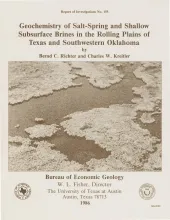
Numerous salt-emission areas exist within the Permian outcrop in the Rolling Plains of Texas and southwestern Oklahoma. Sodium chloride waters underlie the area at relatively shallow depths, discharge from salt springs and salt seeps, and greatly impair the quality of ground and surface waters. This study distinguishes between brine derived from dissolution of halite by fresh, locally recharged ground water in a shallow ground-water system and brine derived from deep-basin brine aquifers.