This folded transparent map is at the same scale as its corresponding Geologic Atlas of Texas (GAT) sheet and can be superimposed on it to compare gravity information with surface geology.
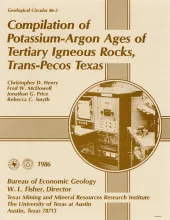
This compilation of potassium-argon (K-Ar) ages of igneous rocks of the Tertiary volcanic field of Trans-Pecos Texas includes all published ages known to us as well as many unpublished results. Almost all age determinations and all published ages of Trans-Pecos rocks are by the K-Ar method, so this compilation essentially includes all isotopic age information. It expands upon an earlier summary by McDowell (1979) by including the considerable number of analyses done since then and by tabulating available rock type, analytical data, and location information.
This folded transparent map is at the same scale as its corresponding Geologic Atlas of Texas (GAT) sheet and can be superimposed on it to compare gravity information with surface geology.
Oil and gas production in Texas peaked in 1972, but the state still contributed 28 percent of oil production and 33 percent of gas production in the United States in 1984. The outlook for future oil and gas supplies in Texas can best be defined by analyzing the trends of the past 10 to 15 years.