
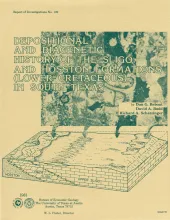
The Sligo and Hosston Formations of Aptian age occur over thousands of square miles in the subsurface of South Texas. These two formations consist of three major coeval parts, Hosston, lower Sligo, and upper Sligo, all three of which were deposited contemporaneously to produce a time-transgressive wedge of sediment. Superimposed on the overall transgressive sequence are numerous progradational cycles composed of shoaling-upward sequences.
The Smackover and lower part of the Buckner Formations (Oxfordian) comprise a thick regressive sedimentary sequence deposited on a Jurassic carbonate ramp. Four major depositional systems are recognized: (1) basinal, (2) low-energy open shelf, (3) high-energy shoal, and (4) sabkha. Lithofacies boundaries within each system and between systems follow paleobathymetrical contours. High-energy grainstone facies were concentrated landward; muddy low-energy facies were deposited seaward.
Variable intensity of diagenesis is the factor primarily responsible for contrasting regional reservoir quality of Tertiary sandstones from the upper and lower Texas coast. Detailed comparison of Frio sandstone from the Chocolate Bayou/Danbury Dome area, Brazoria County, and Vicksburg sandstones from the McAllen Ranch Field area, Hidalgo County, reveals that extent of diagenetic modification is most strongly influenced by (1) detrital mineralogy and (2) regional geothermal gradients.
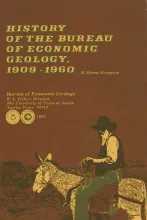
The Bureau of Economic Geology—this bureaucratic title belies the essence of this organization: an ongoing group of professionals with a definite personality. In fact, the history of public geological research in Texas is the story of dedicated, inquisitive scientists shunning the higher salaries and opportunities offered by private enterprise to serve their science and the State of Texas.
Upper Miocene, Pliocene, and Pleistocene deposits in the subsurface of the central Coastal Plain of Texas were subdivided into six operational units comprising the surface-defined Fleming, Goliad, Willis, Lissie, and Beaumont Formations. These sedimentary units constitute the last major depositional episodes in the northwestern Gulf Coast Basin. Late Miocene deposition is represented by transgressive shelf and shallow-marine shales overlain by progradational clastics of the upper part of the Lower Fleming, Upper Fleming, and Lower Goliad-Willis units.