
The Frio Formation is one of the major Tertiary progradational wedges of the Texas Gulf Coast Basin and has yielded nearly 6 billion bbl of oil and 60trillion ft30f gas. The Frio and its updip equivalent, the Catahoula Formation, consist of deposits of two large fluvial and associated deltaic systems centered in the Houston and Rio Grande Embayments. Structures in the Houston Embayment are dominated by syndepositional deformation of underlying Jurassic salt.
The Palo Duro Basin seemingly has all the elements necessary for hydrocarbon generation and accumulation: reservoirs, traps, source rocks, and sufficient thermal maturity. Porous facies in pre-Pennsylvanian, Pennsylvanian, and Permian strata are potential hydrocarbon reservoirs. Within the pre-Pennsylvanian section, shallow-marine carbonates of both Ordovician (Ellenburger Group) and Mississippian age have sufficient porosity and permeability for hydrocarbon accumulation.
Lineaments perceived in remotely sensed images are reliable indicators of geologic structure. Lineaments on ten Landsat multispectral scanner images (band 5; 1:250,000 scale) were mapped covering the Ouachita/Balcones-Luling-Mexia-Talco structural trend between the Rio Grande and Red river in Texas. More than 5,000 lineaments were perceived in these images. Maps depicting the lineaments (individually and in various combinations) were compared with maps of structural/ tectonic features and geothermal gradient contours, noting instances of apparent correlation among these themes.
Surficial geologic investigations at Palestine, Keechi, and Oakwood salt domes have provided information necessary for evaluating these domes as nuclear waste repositories. Diapir growth uplifted sediments to form domes and created complex radial faulting. Cretaceous rocks crop out at Palestine and Keechi Domes, whereas only Eocene Claiborne sediments are exposed over Oakwood Dome. Annular drainage patterns at Oakwood and Palestine Domes reflect the domal structure.
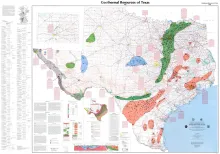
This public-oriented user map shows the generalized extent of geothermal aquifers in Texas. It includes locations and tabular data for selected wells that have representative temperatures and water-quality attributes of the various aquifers.