
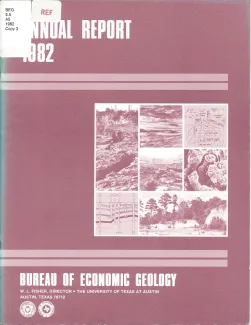
Annual report for the Bureau of Economic Geology 1982
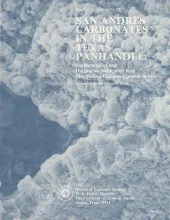
The San Andres evaporitic sequence in the Palo Duro Basin comprises several thick carbonate units in its lower part and many thin units in its upperpart. To the south, across the Northern Shelf of the Midland Basin, evaporites pinch out and carbonates predominate. Six lithofacies were differentiated in the Palo Duro and Northern Shelf carbonates: dolomudstone, pellet-oolite packstone-grainstone, filamentous (Girvanella-like) grainstone, sponge spicule packstone, wispy-laminated crinoid packstone, and skeletal packstone-grainstone.
The Oligocene-Miocene fluvial uranium host aquifers of the South Texas uranium province were deposited principally as syndepositionally oxidized sands and muds. Early intrusion of reactive sulfide- enriched waters produced large intrastratal islands of epigenetic sulfidic alteration, which contain isotopically heavy pyrite exhibiting unique replacement textures. The only known reservoir containing such sulfidic waters is the deeply buried Mesozoic carbonate section beneath the thick, geopressured Tertiary basin fill.