
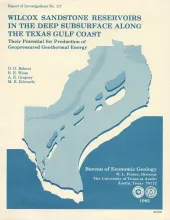
Regional studies of the lower Eocene Wilcox Group in Texas were conducted to assess the potential for producing heat energy and solution methane from geopressured fluids in the deep-subsurface growth-faulted zone. However, in addition to assembling the necessary data for the geopressured geothermal project, funded by the U.S. Department of Energy, this study has provided regional information of significance to exploration for other resources such as lignite, uranium, oil, and gas.
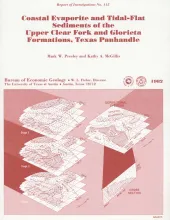
Red beds, evaporites, and carbonates of the upper Clear Fork and Glorieta Formations (Permian) of the Texas Panhandle form an association of facies deposited in nearshore and supratidal environments along an arid coastline. Carbonates were deposited in inner-shelf depositional environments and exhibit upward-shoaling, sabkha-like successions of dolomitic mudstones containing nodular anhydrite. Landward of the shoaling carbonates was a vast salt plain, or sabkha, in which evaporites were deposited in supratidal brine pans and salt flats.
The Fort Worth Basin, in North-Central Texas, is a late Paleozoic foreland basin that was downwarped during the Early to Middle Pennsylvanian Period in response to tectonic stresses that also produced the Ouachita Thrust Belt. The Atoka Group was deposited during the initial westward progradation of chert-rich terrigenous clastics derived both from the Ouachita Thrust Belt and locally from the Muenster Arch across the northern part of the basin. At the northern end of the basin, the Atoka Group interfingers with arkosic conglomerates (granite wash) derived from the Red River-Electra Arch.