
Petrographic and geochemical studies of caprock core from two salt domes, Gyp Hill in South Texas and Oakwood in East Texas, reveal the significantly different diagenetic histories of each dome. Cap rock on Gyp Hill is now forming within a shallow meteoric aquifer. In contrast, cap rock on Oakwood Dome formed principally during the geologic past within deep, saline aquifers in the East Texas Basin. Gyp Hill cap rock, which is 890 ft (271 m) thick, is composed of 490 ft (149 m) of anhydrite overlain by 400 ft (122 m) of gypsum.
The Nacatoch Formation of the East Texas Basin is the middle formation of the Navarro Group and consists of marine sandstones and mudstones derived largely from source areas to the northwest, north, and northeast of the East Texas Embayment. Terrigenous clastics were supplied to the Nacatoch Basin by a major northeastern dispersal system originating in southwest Arkansas. Three minor fluvial-delta systems contributed sediment in southern Red River, Delta, and Hunt Counties, Texas.
Texas has long been a major oil province, accounting for nearly 40 percent of the historic production of crude oil in the United States. Texas now holds less than 30 percent of the Nation's proven reserves and less than 15 percent of its estimated as-yet-undiscovered oil. Discovery and conventional production of oil in Texas have peaked, but more than 100 billion barrels of oil now classed largely as unrecoverable still exist in Texas. This oil, even with the geologic, technical, and economic constraints on its recovery, constitutes a major target for future production.
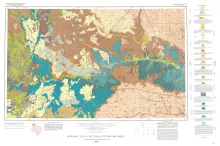
Geologic map that depicts the surface geology of Oldham County and parts of Hartley, Deaf Smith, Moore, Potter, and Randall Counties.
Since early 1977, the Bureau of Economic Geology has been evaluating several salt-bearing basins within the State of Texas as part of the national nuclear waste repository program, The Bureau, a research unit of The University of Texas at Austin, is conducting a long-term program to gather and interpret all geologic and hydrologic information necessary to describe, delineate, and evaluate salt-bearing and related strata in the Pals Duro Basin and vicinity.