
Texas lignite occurs in three Eocene (lower Tertiary) geologic units--the Wilcox Group, Jackson Group, and Yegua Formation--and in three ancient depositional systems--fluvial, deltaic, and strandplain/lagoonal. Near-surface resources in Texas at depths between 20 and 200 ft (6.1 and 61 m) in seams 3 ft (0.9 m) or thicker are 23,377 million short tons (21,208 million metric tons) and are dominantly fluvial in origin. More than 90 percent of the resources occur in the Wilcox and Jackson Groups north of the Colorado River.
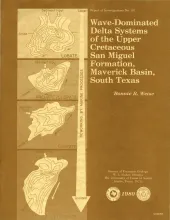
Upward-coarsening sandstone units of the Upper Cretaceous San Miguel Formation in South Texas were deposited in wave-dominated deltas during minor regressive phases, periodically interrupting a major marine transgression. Sediments accumulated in the Maverick Basin within the Rio Grande Embayment. Cross sections and sandstone maps reveal that during deposition of the San Miguel, the Maverick Basin consisted of two subbasins that received sediments from the northwest and the north.
Lower Permian (Wolfcampian) strata of the Palo Duro Basin consist of thick, terrigenous clastic and carbonate facies that were deposited in (1) fan-delta, (2) high-constructive delta, (3) carbonate shelf and shelf-margin, and (4) slope and basinal systems. Through Early Permian time, terrigenous detritus was eroded from surrounding highlands and transported by fluvial processes into the Palo Duro Basin.
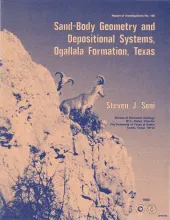
The Neogene Ogallala Formation is an alluvial apron that occurs east of the Rocky Mountains from South Dakota to the Southern High Plains of Texas. The Ogallala was deposited by coalescent, low-gradient, wet alluvial fans that headed in mountains to the west. Geometry and depositional facies of the Ogallala Formation in Texas north of the 33rd parallel have been determined from outcrop studies and drillers' log descriptions.
The Catahoula Formation is composed of ancient fluvial sediments that controlled a wide range of water/sediment interactions responsible for uranium mobilization, transportation, and concentration.