Annual report for the Bureau of Economic Geology 1990
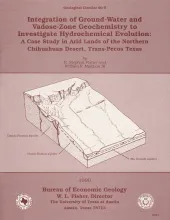
The hydrochemical history of ground water in the arid southeastern Hueco Bolson and southwestern Diablo Plateau was investigated by collecting soil-moisture samples from unsaturated siliciclastic bolson-fill sediments and groundwater samples from the Diablo Plateau aquifer, the Hueco Bolson silt and sand aquifer, and the Rio Grande alluvial aquifer. Major, minor, and trace solutes, stable isotopic compositions, and activities of tritium and carbon-14 were measured in ground-water samples; major solute concentrations were determined in soil-moisture samples.
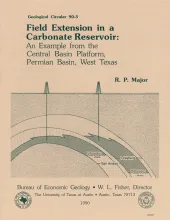
Reexploration of old fields in mature hydrocarbon provinces, such as the Permian Basin of West Texas and New Mexico, may significantly increase known oil and gas reserves. Data from old wells are being reevaluated in light of current oil and gas prices using new geologic and engineering reservoir models, in discovery of untapped hydrocarbn-producing zones.
Occurrences of ground-water and soil salinization are numerous in the Concho River watershed and its confluence with the Colorado River in West Texas and in other semiarid regions of Texas and the United States. Salinization results from both natural and anthropogenic processes, which can occur together or separately. To recognize regional salt-water sources and understand salinization mechanisms in the Concho River valley, we investigated chemical and physical characteristics associated with saline ground water.