Publication Search

Store logo

Latest Publications:

Publication Year
1973
Series
Guidebook
Abstract

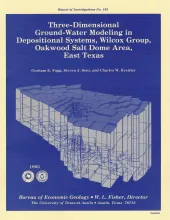
This field guide is designed to provide an opportunity to observe a variety of facies that are the fundamental blocks with which principal depositional systems have been fabricated. Available data is provided and a genetic interpretation is proposed. Although the validity of the interpretation may be questioned, it is anticipated that the interpretation will focus attention on the problems and limitations of facies interpretation in basin analysis.

Publication Year
1973
Series
Environmental Geologic Atlas of the Texas Coastal Zone
Abstract

The Texas Coastal Zone is marked by diversity in geography, resources, climate, and industry. It is richly andowed with extensive petroleum reserves, sulfur and salt, deep-water ports, intracoastal waterways, mild climate, good water supplies, abundant wildlife, commercial fishing resources, unusual recreational potential, and large tracts of uncrowded land in close proximity to major population centers.

Keywords
Publication Year
1973
Series
Geological Circular
Abstract

The Allamoore district of Hudspeth and Culberson counties, Texas, has become one of the most significant talc-producing areas of the United States. Exploitation of talc deposits in the district began in 1952 with a cumulative production of 120,000 tons through 1957 (Flawn, 1958). With continued growth, annual production exceeded 160,000 tons in 1968, making the district second only to New York State in national output, Moderate- to large-sized deposits have been developed with near-surface parts inexpensively extracted. Talc reserves are estimated in the tens of millions of tons.

Author
Publication Year
1972
Series
Report of Investigations
Abstract

Mountain-bounded basins or bolsons are the most important aquifer systems throughout most of southwestern and western United States and northern Mexico. The dissection of the Presidio Bolson by the Rio Grande and its tributaries has afforded an ideal situation for detailed study of the stratigraphy of one of these important aquifer systems. The results of this investigation provide a framework for understanding the relationships between the types and distribution of bolson-fill sediments and the occurrence of ground water in desert basins in the United States and Mexico.

Publication Year
1972
Series
Report of Investigations
Abstract

Fresh-water pond deposits at Ingleside, San Patricio County, Texas, have yielded a large Pleistocene vertebrate fauna. The bones are derived from calcareous sands and marls which overlie a marine lagoonal clay. The locality is located just west of the axis of Live Oak Ridge. This ridge, along with the Ingleside Terrace to the east, was formed as a barrier island and lagoon when sea level was higher than at present.