
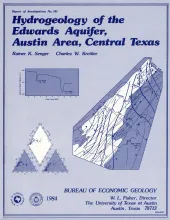
The Edwards Formation, on the downthrown side of Mt. Bonnell fault in the Austin, Texas, area (Hays and Travis Counties), is part of the northeastern extension of the Edwards Underground Reservoir, the primary source of water in numerous counties along the Balcones Fault Zone. Recharge to the aquifer is supplied mainly by creeks that cross the Balcones Fault Zone southwest of Austin. Barton Springs is the major point of discharge. Changes in water levels of wells in the area correlate positively with changes in discharge at Barton Springs, suggesting good interconnection.
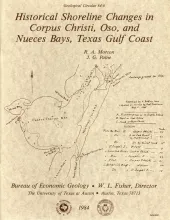
Changes in the position and stability of shorelines around Corpus Christi, Oso, and Nueces Bays, Texas Gulf Coast, were documented using historical-monitoring techniques.
Deep-water sandstones of the Oligocene-age Hackberry unit of the Frio Formation contain significant quantities of oil and gas and remain potentially one of the most productive exploration targets in southeast Texas. The Hackberry is a wedge of sandstone and shale containing bathyal fauna that separates upper Frio barrier-bar - strandplain sandstones from lower Frio neritic shale and sand. Major Hackberry sandstones lie atop a channeled unconformity that forms the base of the unit.
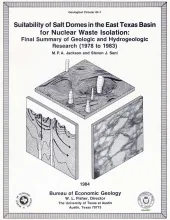
This report summarizes results of the East Texas Waste Isolation (ETWI) program from January 1, 1978, to March 30, 1983. Having an extensive data base, the study comprised 33 different lines of research by 67 scientists and research assistants. The program included both basinwide and site-specific (mainly around Oakwood Dome) studies that used surface and subsurface data.
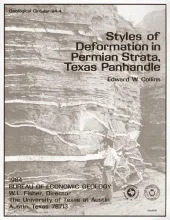
Permian strata in the Texas Panhandle exhibit a variety of deformation styles that are attributed to tectonic stresses as well as to collapse caused by evaporite dissolution. At Caprock Canyons State Park, deformation structures above salt dissolution zones include veins, faults, and folds. The geometry and distribution of the structures indicate that systematic regional joints older than the dissolution collapse have influenced salt dissolution.