
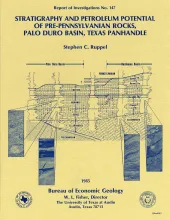
Pre-Pennsylvanian rocks in the Palo Duro Basin include (1) basal transgressive marine Cambrian(?) sandstones deposited over Precambrian basement, (2) overlying Lower Ordovician dolomites of the Ellenburger Group that formed when shallow seas covered much of the North American continent, and(3) Mississippian limestones and dolomites deposited when the area was inundated again after middle Paleozoic uplift and erosion. A generally similar stratigraphic sequence exists in the adjacent Dalhart and Hardeman Basins.
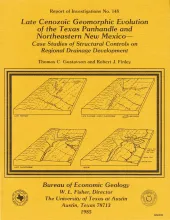
Salt dissolution has affected parts of the Upper Permian Salado, Seven Rivers, San Andres, Glorieta, and upper Clear Fork Formations beneath the Pecos River valley in eastern New Mexico and has been active beneath the Canadian River valley and the Rolling Plains of the Texas Panhandle. Extensive dissolution of the salts of the Salado and Seven Rivers Formations has also occurred beneath the Southern High Plains. Cumulative thickness of salt lost to dissolution exceeds 150 m (500 ft) along the western, northern, and eastern margins of the Palo Duro Basin.
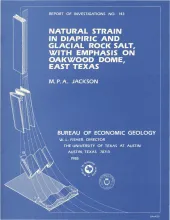
Structural styles in the gravity-driven, ductile flow processes of glaciers and diapirs are analyzed. When dampened by rainfall, salt glaciers flow rapidly under minute differential stress. Thus, the concentration of water in diapiric rock salt is crucial to predicting creep rates in a repository medium. Natural-strain rates of rock salt range greatly from 10-8/s to 10-16/s; rates of average diapiric uplift are slowest.
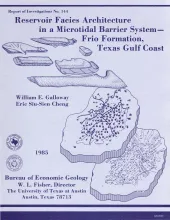
Sandstone reservoirs deposited in microtidal barrier systems contain large oil and gas reserves in several Gulf Coast Basin plays. Three representative Frio Sandstone reservoirs in West Ranch field show that barrier-island sand bodies are complex mosaics of barrier-core, inlet-fill, flood-tidal-delta, washover-fan, barrier-flat, and shoreface facies. The proportions of these facies differ within progradational, aggradational, and transgressive barrier sand bodies.
Bedded salt of the Permian San Andres Formation, Palo Duro Basin, Texas, is under consideration for the isolation of high-level nuclear waste. To represent the variety of salt types present, 150 large (250 to 500 g), intact samples of bedded halite from the San Andres Formation and other saltbearing units were selected and then analyzed by a standardized procedure. The halite fraction of the sample was dissolved in anhydrous methanol by continuous reflux Soxhlet extraction, and the water content was measured by Karl Fischer titration.