
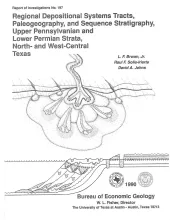
Sixteen depositional sequences, commonly called cyclothems, each composed mostly of limestone(retrogradational/transgressive) and siliciclastic (progradational/regressive) subsequences, or systems tracts, record the paleogeography during Late Pennsylvanian (Virgilian Epoch) and Early Permian (Wolfcampian Epoch) Periods on the Eastern Shelf and adjacent Midland Basin, North-Central Texas.
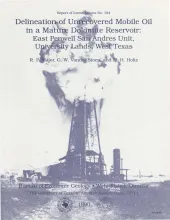
The East Penwell San Andres Unit produces from a depth of approximately 3,400 ft (1,040 m) on the east flank of a broad, low-relief anticline on the east side of the Central Basin Platform of the Permian Basin in Ector and Crane Counties, West Texas. Since discovery in 1927 the unit has produced 43 million barrels of primary and waterflood oil of an estimated 164 million barrels of original oil in place. Approximately 30 million barrels of mobile oil remains in the main reservoir of this unit.
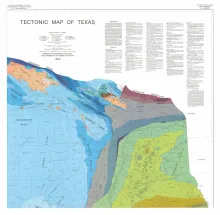
4 oversized sheets, Lambert Conformal Conic projection based on standard parallel 33 degrees and 45 degrees. Accompanied by a text booklet, The Tectonic Framework of Texas.
Geologic mapping and fracture analysis of the Lower Cretaceous Edwards aquifer strata near Georgetown and Round Rock, Texas, were performed to provide a better understanding of the geologic framework of the Balcones Fault Zone and to provide information for assessing ground-water flow characteristics. Cretaceous strata dip gently eastward and are locally overlain by terrace deposits and alluvium. Several major normal faults, downthrown to the east, strike northward across the area. Gentle flexures, possibly related to faulting, parallel the faults.