
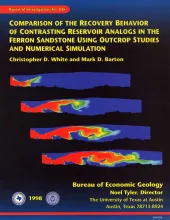
Fluvial-deltaic reservoirs contain large volumes of oil and gas. These reservoirsandstones may have complex stacking patterns, and shales or very fine grained sandstone may form baffles or barriers to flow. As a result, significant compartmentalization or baffling may occur in fluvial-deltaic reservoirs. Because of their close analogy with reservoirs in the Gulf of Mexico region, outcrops of Ferron Sandstone in central Utah have been used to investigate the heterogeneity and possible recovery behavior of high-accommodation fluvial-deltaic reservoirs.
The author of this research mapped strata, facies, and permeability trends through a compasite valley-fill standstone in the Fall River Formation, exposed in Red Canyon, South Dakota. Findings demonstrate the complexity of depositions formed in low-accommodation basin settings. The Fall River Formation is a 45-m-thick layer of fluvial-dominated valley fills and shore-zone strata deposited on the stable cratonic margin of the Cretaceous Western Interior Seaway.