
Publication Year
1998
Publisher
Series
Open-File Map
Publication Year
1998
Publisher
Series
Open-File Map
Publication Year
1998
Publisher
Series
Open-File Map
Publication Year
1998
Publisher
Series
Open-File Map
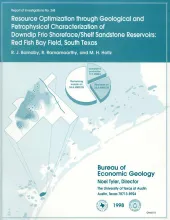
Publication Year
1998
Publisher
Series
Report of Investigations
Abstract
Located in Nueces County, 5 mi southeast of Aransas Pass in Corpus Christi Bay, Red Fish Bay field has yielded more than 19 MMbbl of liquid hydrocarbons and 103 Bcf of gas from more than 50 stacked Frio Sandstone reservoirs since field discovery in 1950. This study forcused on delineating bypasssed hydrocarbons in 19 upper Frio reservoirs. Red Fish Bay field exemplifies the tremendous bypassed hydrocarbon potential in supposedly depleted sandstone reservoirs of the Downdip Frio BarrierIStrandplain Sandstone on the San Marcos Arch play in SouthTexas.