
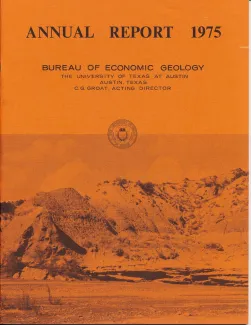
Annual report for the Bureau of Economic Geology 1975
Lignite is a major energy resource in Texas; as the demand for energy re-
sources grows and reserves of oil and gas dwindle, lignite will become the major
fuel potential in the State. That lignite which is strippable by present technology
occurs in two northeast-trending bands in East Texas (fig. 1); 10.4 billion short
tons covering approximately 1 million acres are potentially available for strip
mining (Kaiser, 1974).
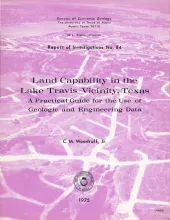
The Lake Travis vicinity lies predominantly within a carbonate rock terrane and is the site of ongoing intensive residential development. Such development may impose adverse environmental effects such as upland erosion, rapid infilling of the lake with sediment, and the ultimate lowering of surface- or ground-water quality. Furthermore, inhabitants may be subjected unwittingly to geologic hazards such as flooding or mass wasting.
The Canyon Group (Missourian Series) is a sequence of westward-dipping, genetically related carbonate and terrigenous clastic facies that crop out in a northeast-southwest belt across North-Central Texas. The section includes stratigraphic units between the base of the Palo Pinto Limestone and the top of the Home Creek Limestone.