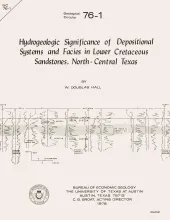
The Lower Cretaceous Hosston and Hensel Sandstones are important sources of ground water in North-Central Texas. Delineation of major depositional systems and their component facies within these formations provides a method for predicting the quantity, movement, and chemical composition of water in the aquifers. The Hosston and Hensel Sandstones were deposited during minor reversals of marine transgression onto the Texas craton by Comanchean (Lower Cretaceous) seas.
The Bureau of Economic Geology has been conducting regional studies of the Frio Formation along the Texas Gulf Coast to evaluate potential geothermal energy from deep, geopressured sandstone reservoirs (Bebout, Dorfman, and Agagu, 1975; Bebout, Agagu, and Dorfman, 1975). The procedures used in this evaluation were reviewed at the Second Geopressured Geothermal Energy Conference held at The University of Texas at Austin and sponsored by the United States Energy Research and Development Administration. The index map (fig. 1) and cross sections (figs.