
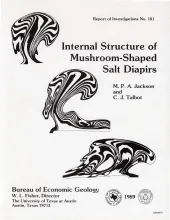
Mushroom-shaped diapirs have an overhanging bulb fringed by one or more skirts (peripheral pendant lobes), which can curl inward to form vortices capable of entraining cover rocks to various degrees. The highly complex anatomy of mushroom diapirs, some of which have double and eventriple cores, is analyzed in centrifuged and natural diapirs. We conducted 8 centrifuge experiments, which produced more than 100 model diapirs under acceleration equivalent to 1,200 times that of gravity. The experiments were dynamically scaled to U.S.

The State-owned submerged lands of Texas encompass almost 6,000 mi2 (15,540 km2). They lie below waters of the bay-estuary-lagoon system and the Gulf of Mexico and extend 10.3 mi (16.6 km) seaward from the Gulf shoreline (fig. 1). The importance of these lands and their resources to resident flora and fauna as well as to people is well known and documented; more than one-third of the state's population is concentrated within an area of the Coastal Zone that is only about one-sixteenth of the state's land area.
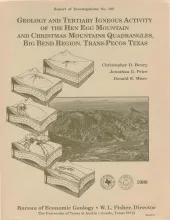
Cretaceous sedimentary rocks and Tertiary intrusive, extrusive, and volcaniclastic rocks dominate the geology of the Hen Egg Mountain and Christmas Mountains quadrangles in the Big Bend region of Texas. The Cretaceous rocks consist of limestones, shales, mudstones, and sandstones that are host rocks for the Tertiary intrusions.This report focuses on the Tertiary intrusive and extrusive rocks. The intrusions were emplaced in several distinct intervals between 47 and 20 Ma ago (Eocene to Miocene) but are dominantly 44 to 40 Ma old.
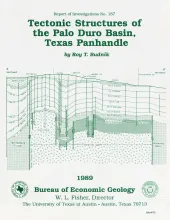
The Palo Duro Basin is a broad structural low in the southern Texas Panhandle that formed as a result of nearly continuous Pennsylvanian and Permian subsidence. True complexity of this basin is unknown because of the sparsity of structural information. However, surface and subsurface studies, including examinations of outcrop, well log, and seismic reflection data, indicate that structures within and adjoining the basin consist primarily of small, fault-bounded, isolated, positive basement areas and poorly defined subbasins.
Successful development of low-permeability-sandstone gas reservoirs depends on an understandingof their natural fracture patterns and on predictions of the orientation of horizontal stresses.This report describes the preliminary results of fracture analysis of the Lower Cretaceous TravisPeak Formation, a tabular sandstone and shale unit approximately 2,000 ft (610 m) thick thatproduces gas from low-permeability (less than 1 md) sandstone in much of East Texas. Depth to thetop of the formation ranges between 5,900 and 9,500 ft (1,798 and 2,895 m) in the study area.