
Fresh-water pond deposits at Ingleside, San Patricio County, Texas, have yielded a large Pleistocene vertebrate fauna. The bones are derived from calcareous sands and marls which overlie a marine lagoonal clay. The locality is located just west of the axis of Live Oak Ridge. This ridge, along with the Ingleside Terrace to the east, was formed as a barrier island and lagoon when sea level was higher than at present.
The Eastern Shelf was a constructional platform developed on the margin of the sediment-starved Midland Basin during Late Pennsylvanian and Early Permian time. A mixed terrigenous-carbonate sedimentary province characterized the shelf during most of its history. Sediments were derived from highlands to the east and northeast. Along the outcrop in Eastland, Stephens, Young, and Jack counties, uppermost Pennsylvanian beds comprise the Harpersville Formation, a boundary-defined rock stratigraphic unit within the Cisco Group.
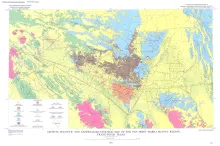
The Van Horn-Sierra Blanca region lies athwart part of the boundary between two contrasting geologic provinces. The contrast between these two provinces, splendidly displayed by Holocene landforms in the present map area, has a history that dates back to at least Late Precambrian time. This remarkable contrast led R. T. Hill (1902) to suggest the possibility of a transcontinental fracture zone passing near Van Horn and along the boundary of the provinces.
The Texas Coastal Zone is marked by diversity in geography, resources, climate, and industry. It is richly andowed with extensive petroleum reserves, sulfur and salt, deep-water ports, intracoastal waterways, mild climate, good water supplies, abundant wildlife, commercial fishing resources, unusual recreational potential, and large tracts of uncrowded land in close proximity to major population centers.