


"When in the early 1980’s it became known that the Federal Government was planning to undertake the construction of the massive Superconducting Super Collider (SSC) project, scientists in the various states, still without precise information on the criteria to be established for site selection, began to seek ways in which they, and their states, could participate in the project.
Oil and gas resources on University Lands, 2.1 million acres in 19 West Texas counties, constitute a major asset of the University of Texas System. The original oil in place (OOIP) of the 102 major University Lands oil reservoirs is calculated to be 7,520 MMbbl. Components of the calculated OOIP include residual oil (3,761 MMbbl, 49 percent), cumulative production (1,702 MMbbl through 1999, 23 percent), remaining reserves (125 MMbbl, 2 percent), and unrecovered mobile oil (1,932 MMbbl, 26 percent).
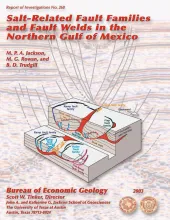
We classify salt-related faults and fault welds in the northern Gulf of Mexico on the basis of the three-dimensional geometry of the faults, welds, deformed strata, and associated salt bodies. Kinematic or genetic criteria are not used in the classification, although we comment on these aspects where they are helpful.
Use of groundwater-flow models for prediction of future availability of water resources is standard practice. Having accurate hydraulic parameters for input into groundwater-flow models is critical to the generation of realistic local and regional water-resource management plans. Transmissivity, hydraulic conductivity, and storativity are some of the important parameters needed for developing numerical groundwater-flow models.