
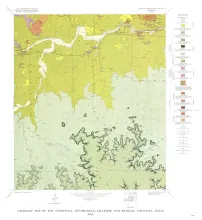
Stonewall quadrangle includes part of the southern margin of the Llano region and part of the eastern margin of the Edwards Plateau where most of the plateau suriace has been destroyed by erosion. An east-northeastward-trending lobe of the Edwards Plateau crosses the quadrangle near its southeastern corner. The area to the north is in the broad gently rolling Pedernales River basin, and that to the southeast is in a more rugged marginal part of the Blanco River drainage area. The geology of the Stonewall quadrangle is shown on a U.S.
At five places along the outcrop of the Wellborn Formation in Lee and Burleson counties, Texas, anomalously high gamma radiation is associated with concentrations of heavy minerals. The most abundant heavy minerals are ilmenite, magnetite, and zircon. The radiation is emitted by some radioactive element in zircon. The intensity of the radiation and the areal extent of the radiation anomalies were measured by a scintillation counter.
In the past 100 years, more than 100 names have been used to designate parts or all of the outcropping Midway and Wilcox rocks in the Gulf Coastal Plain; less than half of these names are used currently by Coastal Plain geologists, and the validity of some of the remaining named rock units has been questioned in certain recent studies. A compilation of these names shows the development of present-day terminology.