The uranium industry, born in boom in the late 1940's and early 1950's, fell upon hard times after about a decade of lusty growth as anticipated private markets failed to develop on schedule and the United States Atomic Energy Commission cut back and stretched out its purchase program. Exploration for uranium in the United States came to a halt. Mills closed down or operated on reduced schedules as contracts expired.
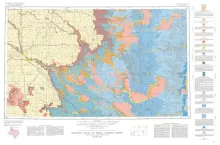
Geologic map that depicts surface geology of Crosby, Dickens, and King Counties and parts of Hale, Floyd, Motley, Cottle, King, Lubbock, Lynn, Garza, Kent, and Stonewall Counties. The Lubbock Sheet honors the late Dr. Halbert Pleasant Bybee, distinguished Texas geologist, professor at The University of Texas at Austin from 1914 to 1925 and 1936 to 1957, and the man who organized, and for many years directed, the University Lands Office in Midland, Texas. Dr.