

This report deals with the occurrence and potential production of industrial sand in the Gulf Coast area of Texas. The study area covers approximately 23,000 square miles underlain by alluvial, deltaic, beach, and eolian deposits of Pleistocene and Recent age. Deposits are intermixed and interbedded sands, gravels, silts, and clays. Sand bodies are irregular in size and shape depending on environment of deposition; they vary in physical character and mineralogical and chemical composition.
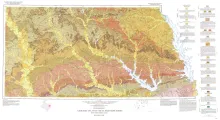
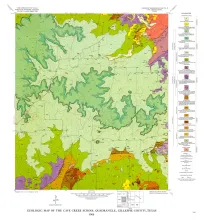
Geologic map that depicts the surface geology of Nacogdoches, Shelby, San Augustine, Sabine, and Angelina Counties and parts of Anderson, Cherokee, Rusk, Newton, Jasper, Tyler, Polk, Trinity, Robertson, Madison, Leon, Freestone, and Panola Counties, Texas. This map was published in honor of Sidney Powers, who was one of the leading geologists of his generation and who was classed by many as the most proficient geologist in the oil industry before his death in 1932.

The uranium industry, born in boom in the late 1940's and early 1950's, fell upon hard times after about a decade of lusty growth as anticipated private markets failed to develop on schedule and the United States Atomic Energy Commission cut back and stretched out its purchase program. Exploration for uranium in the United States came to a halt. Mills closed down or operated on reduced schedules as contracts expired.
The San Saba Member of the Wilberns Formation of central Texas is mostly coarse-grained, trilobitic limestone that grades eastward to dolomite and contains sandstone intervals in its westernmost exposures. Faunas from the limestone place the middle part of the San Saba within the Trempealeauan Stage (Saukia zone) of the Upper Cambrian, but the uppermost part belongs to the Lower Ordovician. Three subzones within the Saukia. zone are described.