
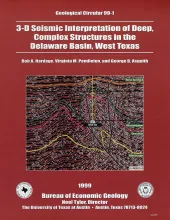
A multidisciplinary reservoir-characterization study of the Ellenburger Group was conducted over a 176-mi2 3-D seismic grid in Pecos, Reeves, and Ward Counties in the southern Delaware Basin of West Texas. The study area covered Lockridge, Waha, and West Waha fields and parts of Worsham-Bayer and Coyanosa fields, which have produced 1.3 trillion standard cubic feet of natural gas since their discoveries in the 1960's. Seismic time-structure and depth maps were generated for the tops of the Bone Spring-3, Mississippian, Devonian (Woodford), and Ellenburger.
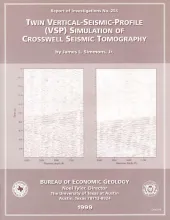
Researchers in crosswell seismic tomography attempt to image interwell velocity fields by using traveltimes of transmitted waves generated by a downhole source and recorded by downhole receivers. These traveltimes are governed by subsurface velocities along their travel paths, which in turn provide the basis for adjusting an initial-velocity model such that the traveltimes predicted by ray tracing best-match observed traveltimes.
Between 1951 and 1996, groundwater pumpage from the Carrizo-Wilcox aquifer, one of Texas' major aquifer systems, increased in the area between the Colorado and Brazos Rivers from approximately 10,600 to 37,900 acre-ft/yr, primarily as a result of mining needs. Continued (and possibly greatly accelerated) growth in groundwater demand for a variety of uses is expected through the year 2050.