

The Ellenburger Group (Lower Ordovician) of Texas is a laterally extensive peritidal carbonate shelf sequence. It forms a major deep oil reservoir, having estimated reserves of 1.15 billion barrels of oil, and it also contains an estimated 2.2 billion barrels of oil equivalent.
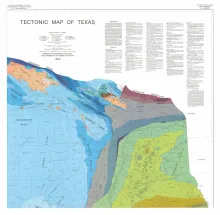
4 oversized sheets, Lambert Conformal Conic projection based on standard parallel 33 degrees and 45 degrees. Accompanied by a text booklet, The Tectonic Framework of Texas.
Remotely sensed features such as linear drainages, escarpments, ridges, and aligned playas have been identified on Landsat imagery (scale 1:250,000) of the Texas Panhandle and adjacent regions to allow comparison of these features with detailed regional and site-specific geologic data. Physiographic subdivisions of this area are the High Plains, Canadian Breaks, Rolling Plains, Pecos Valley, and Raton section.
The East Penwell San Andres Unit produces from a depth of approximately 3,400 ft (1,040 m) on the east flank of a broad, low-relief anticline on the east side of the Central Basin Platform of the Permian Basin in Ector and Crane Counties, West Texas. Since discovery in 1927 the unit has produced 43 million barrels of primary and waterflood oil of an estimated 164 million barrels of original oil in place. Approximately 30 million barrels of mobile oil remains in the main reservoir of this unit.