
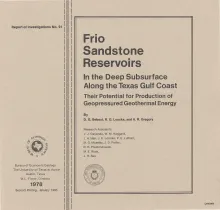
Tertiary strata of the Texas Gulf Coast comprise a number of terrigenous depositional wedges, some of which thicken abruptly at their downdip ends as a result of contemporaneous movement of growth faults and underlying salt.
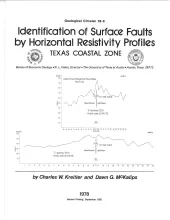
The land surface in the Texas Coastal Zone is interlaced with active and potentially active surface faults. They are subtle features which are difficult to identify until they have caused damage to manmade structures. To date (1978), significant damage has resulted. Faults intercept 2 airports, interstate highways at 11 different locations, and railroad tracks at 28 locations. Faults also pass through 11 residential communities. More than 200 houses in these communities in Harris and Galveston Counties show structural damage because of faulting.
Barrier islands along the Texas Coastal Zone are part of a complex and dynamic system represented by many distinct yet interrelated environments affected by a variety of resources, natural processes, climatic conditions, and human activities. Because of the increasing realization that island resources are extremely important both as natural systems and as valuable recreational areas, the necessity of understanding their complexities and how man and his activities interact with them becomes more and more urgent.