
Vermiculite deposits in the Central Mineral region of Texas, chiefly in Precambrian metamorphic rocks, are situated in Llano County and adjacent parts of Mason, Gillespie, and Burnet counties with minor occurrences in Blanco and San Saba counties. All of the known deposits contain a lesser percentage of vermiculite than the deposits now being exploited in South Carolina and Montana; however, the deposits are substantial in size and will probably be mined when the richer domestic and foreign sources are exhausted.
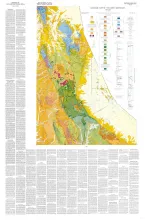
About 10 miles south of Van Horn, Texas, the Van Horn Mountains rise abruptly above an intermontane plain and extend southward to the Sierra Vieja. The area lies primarily in the southwestern part of Culberson County but extends into Hudspeth and Jeff Davis counties. The mountains owe their present topographic form to late Tertiary block-faulting. Structurally, they are a northward-trending horst which is flanked on the east and west by intermontane basins.
The Ogallala formation extends from the north side of the Pecos Valley northward across western Texas, Oklahoma, Kansas, and Nebraska into southern South Dakota. With its southern limit within the Edwards Plateau, it underlies the upland surface of much of the High Plains section of the Great Plains Province. The extensive fluvial deposits of Neogene age are widely exposed throughout the dissected plateau region that flanks the Rocky Mountains on the east. The deposits have yielded large faunas of fossil vertebrates and mollusks and an abundance and variety of fossil plant seeds.