
The West Chinati stock, well exposed in San Antonio Canyon and immediately westward on slopes of the southwestern part of the Chinati Mountains, Presidio County, Texas, is a large stocklike body of porphyritic hornblende granite cut by numerous dikes and irregular-shaped plutons of rhyolite, rhyolite porphyry, microgranite, trachyte porphyry, diorite, and igneous breccia.Fissure veins developed in wide and long sheeted zones which strike E-W and N. 50" E.
This Guidebook represents an updating of Bureau of Economic Geology Guidebook No. 5, Field Excursion-Geology of Llano Region and Austin Area. It also represents a modification of Geology of the Llano Region and Austin Area, Texas, published by the Shreveport Geological Society in 1971.
Regional surface and subsurface studies indicate that thick deltaic (Queen City Formation) and thin shelf (Reklaw and Weches Formations) sequences compose the stratigraphic interval between the top of the Carrizo Sand and the base of the Sparta Formation. In East Texas, the Queen City Formation accumulated as part of a high-constructive, lobate delta system; and in South Texas, as part of a high-destructive, wave-dominated delta system. In South Texas, principal facies are meanderbelt sand, lagoonal mud, stacked coastal barriers, and prodelta shelf mud facies.
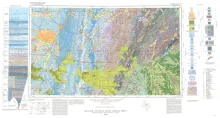
Geologic map that depicts the surface geology of Shackelford, Stephens, Palo Pinto, Callahan, and Eastland Counties and parts of Jones, Taylor, Runnels, Coleman, Brown, Comanche, Erath, Parker, and Hood Counties, Texas.
Endemic ammonite faunas evolved from cosmopolitan faunas in a series of successive episodes over about 35 million years of the Cretaceous of the Gulf Coast of the United States. During basin-basin-margin tectonic adjustments the Cretaceous barrier reef was inundated or circumvented so that a cosmopolitan fauna entered the back-reef area. Gradual isolation of the fauna behind the barrier produced endemism. With the next basin adjustment the endemic fauna became extinct, and a new cosmopolitan fauna migrated into the back-reef area, likewise evolving into an endemic fauna in its turn.