
Oakwood salt dome in Leon and Freestone Counties, Texas, has a core composed of a diapiric salt stock at a depth of 355 m. A vertical borehole in the center of the salt stock yielded 57.3 m of continuous rock-salt core overlain by 137 m of anhydrite-calcite cap rock. The lower 55.3 m of rock salt exhibits a strong, penetrative schistosity and parallel cleavage dipping at 30� to 40� and more than 60 variably dipping layers of disseminated anhydrite. Anhydrite constitutes 1.3 � 0.7 percent of the rock-salt core.
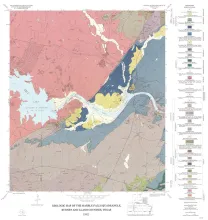
The Oakville Formation consists of sediments deposited by several major fluvial systems that traversed the Texas Coastal Plain during the Miocene Epoch. Facies geometry and composition, together with superimposed structure and topography, are important determinants of ground-water flow, aquifer transmissivity, and regional hydrochemical evolution.
San Andres oil constitutes more than 80 percent of the total production from the Northern Shelf of the Midland Basin, Texas. The San Andres and Clear Fork carbonate rocks of the Northern Shelf contain sufficient amounts of lipid-rich organic material to rank them as potential petroleum source beds. Organic maturation of these rocks, as revealed from vitrinite reflectance and kerogen color, however, is not sufficient to have initiated catagenesis. Therefore, oil within Northern Shelf reservoirs was derived mostly from other sources.
Eocene stratigraphic units in the East Texas Basin are composed of a thick sedimentary sequence (approximately 2,000 ft [600 m]) of fresh-water aquifers and aquitards covering an area of approximately 15,000 mi2 (51,000 km2). Analysis of abundant data on hydraulic head, pressure, and water chemistry from water wells tapping the Wilcox, Carrizo, and Queen City aquifers reveals the regional ground-water circulation patterns, locations and mechanisms of major recharge and discharge areas, and evolution of ground-water chemistry.