
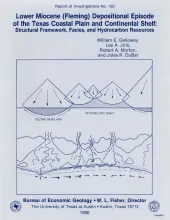
The Fleming Group and its basinward equivalents constitute the stratigraphic record of one of the major Cenozoic depositional episodes of the northern Gulf Coast Basin. The depositional sequence representing the episode is bounded above by the Amphistegina B shale and below by the Anahuac shale. Initially, lower Miocene (Oakville) progradation advanced across the broad submerged shelf platform constructed during earlier Frio deposition. When outbuilding reached the Frio paleocontinental margin, the rate slowed as large-scale growth faulting created a narrow lower Miocene expansion zone.
In the subsurface and at the outcrop, waters in argillaceous deposits of the Calvert Bluff Formation (lower Eocene, Wilcox Group) are brackish to saline. Samples of vadose water from the outcrop of argillaceous beds at Big Brown lignite mine in Freestone County, Texas, have chloride concentrations of as much as 3,500 mg/L and total dissolved solids of as much as 8,000 mg/L. The composition of brackish ground water was probably modified from Eocene seawater by sevenfold to ninefold dilution with rain water.
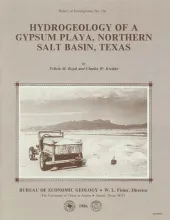
The northern Salt Basin in West Texas and New Mexico is a closed hydrologic system in which discharge of ground-water flow occurs in a series of playas, or salt flats. Ground water originating in peripheral consolidated rocks and alluvial fans flows toward the center of the basin and discharges by evaporation from the salt flats. Progressive increases in salinity are characteristic of the waters moving down gradient and are primarily attributed to evaporative concentration.
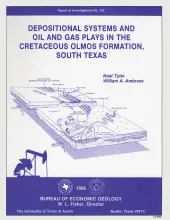
The Upper Cretaceous Olmos Formation in South Texas continues to be an active exploration target 60 years after oil was first discovered in this clastic assemblage. The shallow, oil-bearing formation was deposited on a broad, wave-influenced shelf. Sand accumulated in two depocenters. Initial deposition took place in a western depocenter during an early phase of wave-dominated deltaic sedimentation. Deposition of the strike-elongate delta preceded two cycles of high-constructive deltaic deposition, during which time sediments prograded seaward over the Lower Cretaceous shelf edge.
Near-surface lignite resources in Texas, or those under less than 200 feet (61 m) of cover, are ample to meet the state's demand for lignite in this century. However, meeting demand in the early decades of the next century and beyond will require the recovery of lignite resources below 200 feet (61 m) in the deep basin. Ultimately, the economics of recovery and use of these deep resources will be governed by their quantity, depth, quality, and hydrogeologic suitability.