

The Gas Research Institute, U.S. Department of Energy, and the State of Texas cooperated in joint-venture research to evaluate the infield reserve growth potential of mature gas fields containing conventional reservoirs. Whole cores from fluvial (middle Frio) and deltaic (Vicksburg and Wilcox) reservoirs of the Gulf Coast Basin were compared to diverse types of well logs, analyzed for diagenetic alteration, and calibrated to porosity, permeability, and petrophysical parameters.
A waterflood was begun in 1985 in Taylor-Link West San Andres unit (10 million barrels cumulative production) on the south margin of the Central Basin Platform to capture a remaining mobile oil target estimated at 20 million barrels. From the onset of injection, oil-water ratios of 0.01 or less were recorded, which indicated that a simple, layered reservoir model was inadequate to describe observed performance.
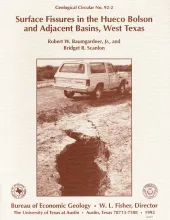
Surface fissures have been observed in many desert basins in the western United States. These surface-collapse features are usually discovered after a normally dry surface has been covered with water, either by runoff from intense rainfall, by flooding, or by irrigation. Their sudden appearance attracts the attention of local residents, especially when the fissures render unpaved roads impassable. Collapse features begin as near-surface tension fractures that are enlarged by erosion and piping.
Grabens overlying diapirs have previously been ascribed to intrusion, withdrawal, or dissolution of salt. We propose, however, that many grabens or half grabens above diapirs form by regional thin-skinned extension of a brittle overburden. This regional extension can initiate and promote piercement of diapiric walls through extremely thick overburdens. This Piercement induced by faulting applies regardless of the overburden density.
Texas has large resources of oil and natural gas that remain unrecovered. Unlike exploration and development in the past, today's remaining resource base does not depend on the discovery of large new fields; rather, the resource base becomes producible reserves by focusing on relatively small production increments. Economic efficiencies can be obtained through the transfer and application of technology, both existing technology and techniques that are as yet undeveloped.