

Incidence of bloating among approximately 600 clay samples from East Texas, ranging in age from Gulfian (Late Cretaceous) to Recent, correlates principally with clay mineralogy-and pH--together an indication of bulk composition--and to a lesser extent with texture, loss on ignition, and content of nonclay refractory minerals. Clay-mineral and pH data permit prediction of bloating with an accuracy of about 80 percent.
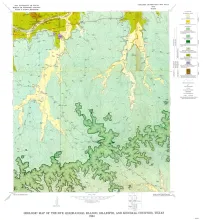
Hye quadrangle includes part of the southeastern Llano region and part of the eastern margin of the Edwards Plateau where most of the Plateau surface has been destroyed by erosion. In the southern part of the quadrangle a narrow lobe of the Edwards Plateau trends east-northeastward from near the southwest quadrangle corner. The area to the north is in the broad gently rolling Pedernales River basin, and that to the south is in a fairly rugged marginal part of the Blanco River drainage area. The geology of the Hye quadrangle is shown on a U. S.
When a reference is made to the mineral resources of Texas, most people think of oil and gas, and some few also of sulfur. And, of course, it is true that of the whopping $4.4 billion dollars’ worth of minerals produced in Texas in 1963, 92% was oil, gas, and natural gas liquids. In 1963, for the 29th year, Texas led the Nation as a producer of minerals. Value of mineral products was twice the value of agricultural products, equal to the value of manufactured products, and equal to about one-half the value of all retail trade.