
Sulfur, along with salt, coal, and limestone, is one of the basic raw materials of the chemical industry. A nation’s per capita sulfur consumption is a reliable index to its chemical production and a rough index to its standard of living. Sulfur, with its many properties, has literally hundreds of uses; most is used in the manufacture of fertilizers, fibers, papers, pigments, pharmaceuticals, and explosives.Sulfur or brimstone is one of the oldest elements known to man. It was used more than 4,000 years ago in rituals of sacrifice and as a bleaching agent for cotton.
Virgil and lower Wolfcamp rocks on the Eastern Shelf in North-central Texas are composed of several intergradational depositional systems comprising 1,200 to 1,500 feet of off-lapping, predominantly terrigenous sediments.
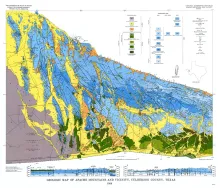
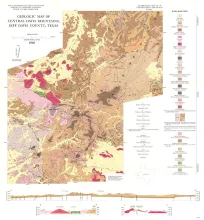
The Davis Mountains are an erosional remnant of a volcanic field that probably covered 5 to 10 times their present areal extent of approximately 2,000 square miles. Many previous workers believed that much of the extrusive material in nearby parts of western Trans-Pecos Texas was erupted from the central Davis Mountains (Colton, 1957, p. 76; Lewis, 1949, p. 89; McAnulty, 1955, p. 54<3; Zabriskie, 1951, p. 36).
Tuff, tuffaceous sand and clay, bentonite, and sandstone containing abundant volcanic rock detritus are present in Gulf Coast Tertiary rocks ranging in age from Eocene to Pliocene. This report summarizes the results of a stratigraphic and sedimentologic study of outcrops of one unit of the sequence, the Gueydan (Catahoula) Formation, from south of the Colorado River, Texas, to the Rio Grande. It is one phase of a study of middle Tertiary volcanism in southern Texas and northeastern Mexico.