
Proterozoic exposures in the Llano Uplift of Central Texas and in the Van Horn area and other smaller areas of western Texas represent less than one percent of the area underlain by Precambrian basement. The geologic units of the Llano Uplift are dominated by felsic gneiss (34 percent), schist (26 percent), and granite (39 percent) that formed during the Mesoproterozoic Grenville orogeny. These lithologies likely form a significant component of the contiguous Texas basement under Phanerozoic strata.
Oil and gas resources in crystalline igneous and metamorphic reservoirs are well documented globally and in Texas. More than 190 oil and gas fields and accumulations with recoverable hydrocarbons in “basement” igneous and metamorphic rocks or volcanogenic extrusive and intrusive rocks around the world have been documented in published literature and unpublished company reports.
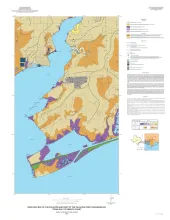
The tectonically quiescent Proterozoic (Texas craton) and Paleozoic (Gulf Coast) basement of Texas shows large contrasts in hydrogeological behavior, from being a fresh-water aquifer, where it crops out, to forming the base of several large sedimentary basins at depths >7 km (>23,000 ft). Little is known about the basement, such as its petrographic distribution and structural features.
The Permian Basin of Texas and New Mexico is an important petroleum province with a complex tectonic history. This region has been shaped by several divergent and convergent deformation events since the Proterozoic Eon. Each subsequent event was influenced by the accumulated tectonic fabric through fault reactivation and strain transfer. These events have generated a complex network of regional faults that have spatially compartmentalized the Permian Basin.