
This history of geology at The University of Texas was prepared for the dedication of the new Geology Building, November 1967. It is a brief history; many details have been omitted. The names of most graduates and some faculty will not be found. The mission was to summarize some important landmarks in Geology at The University of Texas and to describe the personalities and personal relationships that explain many of the decisions that have brought us to the present. I propose a toast to those who have made us what we are.----- Keith Young
The uranium industry, born in boom in the late 1940's and early 1950's, fell upon hard times after about a decade of lusty growth as anticipated private markets failed to develop on schedule and the United States Atomic Energy Commission cut back and stretched out its purchase program. Exploration for uranium in the United States came to a halt. Mills closed down or operated on reduced schedules as contracts expired.
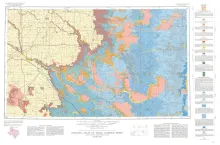
Geologic map that depicts surface geology of Crosby, Dickens, and King Counties and parts of Hale, Floyd, Motley, Cottle, King, Lubbock, Lynn, Garza, Kent, and Stonewall Counties. The Lubbock Sheet honors the late Dr. Halbert Pleasant Bybee, distinguished Texas geologist, professor at The University of Texas at Austin from 1914 to 1925 and 1936 to 1957, and the man who organized, and for many years directed, the University Lands Office in Midland, Texas. Dr.
Based on need for convenient, small-scale cartographic units, the basal Cretaceous rocks in Texas from Red River to Burnet County and on the Callahan Divide are herein divided into three distinctive lithologic sequences.
Limestone is one of the most important nonfuel mineral resources in Texas. Annual production exceeds $30 million; value added in the manufacture of such products as cement and lime amounts to about $100 million annually. Lower Cretaceous limestone is the source of more than 40 percent of the State's total production of limestone and is utilized chiefly as crushed stone (aggregate and constructional stone), sources of raw materials for lime and portland cement, chemical and industrial process stone, agricultural limestone, fluxstone, and dimension stone.