
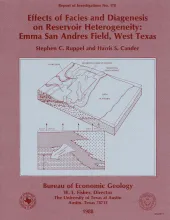
Pervasively dolomitized, anhydritic carbonates of the upper San Andres Formation in the Emma field of West Texas constitute an upward-shallowing sequence of lithofacies representing four major depositional environments. Open Platform fusulinid packstone/wackestone and burrowed wackestone form the base of the sequence. These deposits, which accumulated in a shallow-water, normal marine setting, contain moldic and intercrystalline porosity and constitute the lower of two major porosity intervals in the reservoir section.
Approximately 2,200 ft (670 m) of principally continental and paralic rocks of late Virgilian, Wolfcampian, and early Leonardian age (late Pennsylvanian and early Permian) are exposed in an area of about 4,950 mi2 (12,800 km2) between the Brazos and Red Rivers in North-Central Texas. The stratigraphic complexity of these strata has impeded internal correlation and mapping ever since the rocks were first described by W. F. Cummins in the late 19th century.
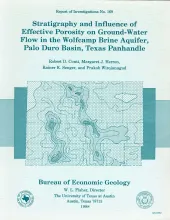
In the Palo Duro Basin, the Wolfcampian Series (lower Permian) overlies Pennsylvanian (primarily Virgilian) strata and underlies the Wichita Group (Leonardian). Tectonic activity from late Pennsylvanian through early Wolfcampian deposition included basement subsidence that resulted in localized basin development.
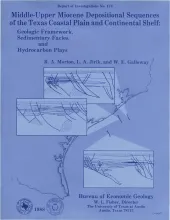
Middle-upper Miocene depositional sequences of offshore Texas represent the last regionally significant influx of terrigenous elastic sediments into the western Gulf Coast Basin.
The Permian Spraberry Trend, once regarded as the world's largest uneconomic oil field, is a prime candidate for reserve growth through extended conventional recovery. More than 9.4 billion barrels (Bbbl) of oil was discovered in the trend, which is part of a giant oil play (10.5 Bbbl of in-place oil) that produces from submarine fan reservoirs of the Spraberry and Dean Formations in the Midland Basin, West Texas.