
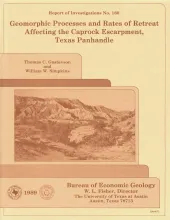
The interaction of geomorphic and ground-water processes has produced the Caprock Escarpmentthat bounds the eastern margin of the Southern High Plains in the Texas Panhandle. Spring sapping,slumping, and piping at the surface and salt dissolution in the subsurface are some of the many erosionalprocesses affecting the escarpment.Substantial thicknesses of bedded Permian salt (halite) have been dissolved from the Salado, SevenRivers, San Andres, and Glorieta Formations beneath the Caprock Escarpment and the Rolling Plains,east of the escarpment.
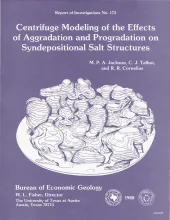
The manner in which sedimentary overburden accumulates significantly influences the growth of syndepositional salt structures. To determine the general principles of this influence for application to specific instances in nature, we carried out 16 experiments using scaled centrifuged models to simulate the effect of variable sedimentary loading on the geometry, kinematics, and dynamics of syndepositional salt structures. This topic has been almost entirely ignored in both physical and mathematical modeling of salt structures.The rheology of four modeling materials was determined.
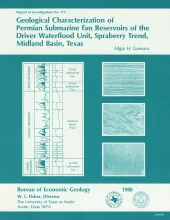
More than 350 well logs and core and production data were used to geologically characterize oil reservoirs of the Driver waterflood unit of the Spraberry Trend in the Midland Basin, West Texas, and to assess the relationship between reservoir stratigraphy and oil recovery.
Natural gas in the United States consists of proved reserves in known reservoirs, of inferred reserves and undeveloped resources within these reservoirs, and of undiscovered resources. Other than proved reserves, all volumes of future natural gas supply are estimates based on information derived from past and current experience in gas production and reservoir development. Even proved reserves are subject to periodic revision.